Gold Penguin — “SPRX Review: The AI-Powered R&D Tax Credit Software”
An independent review of SPRX by Gold Penguin, outlining how the platform supports R&D tax credit documentation and analysis.

John Angelo Yap | Gold Penguin
Oct 10, 2023

Editor’s note This article was originally published by Gold Penguin and authored by John Angelo Yap. It is republished here with permission for reference purposes. Minor formatting edits were made for clarity. The opinions expressed are those of the author and do not constitute tax or legal advice.
Overview
Filing for an R&D tax incentive is widely considered one of the most complex and labor-intensive processes in business taxation. The R&D tax credit, filed on IRS Form 6765, is designed to reward companies for investing in research and development by allowing eligible taxpayers to offset certain federal tax liabilities.
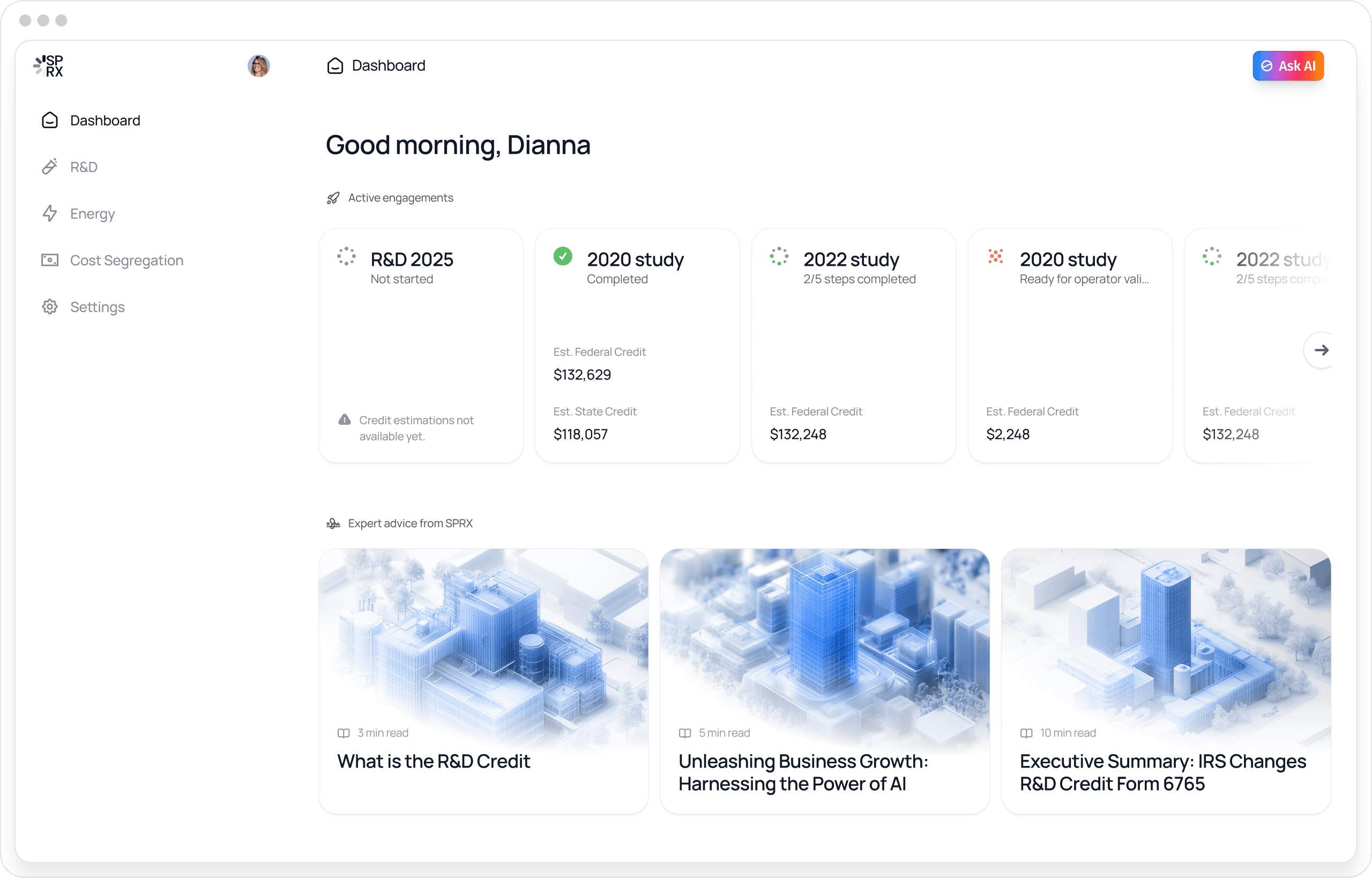
SPRX is an AI-powered software platform built to support companies through the R&D tax credit documentation and analysis process. This review examines how SPRX approaches R&D credit workflows and where it may fit for businesses seeking a more structured alternative to traditional methods.
What is SPRX?
SPRX is a software platform founded in 2020 by Mark Andrus and Dominic Vitucci. The company focuses on helping businesses compute and document R&D tax credits by applying automation and structured analysis to historically manual processes.
The stated goal of SPRX is to simplify the preparation of R&D credit documentation while maintaining alignment with IRS requirements.
Who may benefit from using SPRX?
SPRX may be a fit for companies that engage in qualifying research activities and want to reduce the internal effort required to prepare R&D tax credit studies. This includes businesses with limited in-house tax resources, as well as organizations seeking a more standardized approach to documentation.
How SPRX works
SPRX follows a three-phase workflow:
Step 1: Data collection
Companies provide relevant information related to their R&D activities, including payroll records, general ledger data, project documentation, and supporting materials. Files can be submitted in their native formats, and SPRX supports integrations with certain payroll and accounting systems.
Step 2: Data processing and analysis
SPRX analyzes submitted data to identify activities and costs that may qualify for the R&D tax credit. The platform generates draft documentation and project-level analyses, which are reviewed and validated by experienced R&D tax professionals.
Step 3: Validation and reporting
Once analysis is complete, SPRX produces reports and tax forms consistent with IRS guidance. SPRX does not file tax returns on behalf of customers, but provides materials intended to support filing by the company or its tax advisor.
Key features
Integration with payroll and general ledger systems
Automated workflows for collecting employee input
AI-assisted analysis reviewed by tax professionals
Documentation designed to support substantiation requirements
Access to support from tax and technical specialists
Pros and considerations
Potential benefits
Reduced reliance on spreadsheets and manual interviews
Structured documentation workflows
Combination of automation and professional review
Considerations
Companies remain responsible for providing accurate source data
SPRX does not file tax returns directly
Results depend on the completeness and quality of submitted information
Final thoughts
SPRX represents a technology-forward approach to R&D tax credit preparation. By combining automation with professional oversight, the platform aims to reduce administrative burden while supporting documentation consistency. Companies evaluating R&D tax credit solutions may find SPRX useful as part of their broader tax compliance process.
Original source
Gold Penguin — “SPRX Review: The AI-Powered R&D Tax Credit Software”
Author: John Angelo Yap
Originally published October 10, 2023